The Arabian Business Pulse: Key Trends Shaping the Middle East Economy

Introduction
The Middle East is undergoing a powerful economic transformation. Once primarily associated with oil-driven growth, the region is now emerging as a dynamic hub for innovation, investment, and global commerce. Governments, businesses, and entrepreneurs across the Arabian world are redefining economic priorities, positioning the Middle East as a key player in the future global economy. Understanding these shifts is essential for businesses, investors, and decision-makers looking to engage with one of the world’s most rapidly evolving regions.
Economic Diversification Beyond Oil
One of the most significant trends shaping the Middle East economy is diversification. Countries across the region are actively reducing dependence on hydrocarbons by investing in sectors such as tourism, manufacturing, logistics, financial services, and technology. National transformation programs and long-term visions are accelerating infrastructure development, private-sector participation, and foreign investment, creating more resilient and sustainable economic models.
Rise of Innovation and Digital Economies
Digital transformation is redefining how businesses operate in the Middle East. Governments are embracing smart city initiatives, digital governance, and fintech ecosystems, while private enterprises are rapidly adopting artificial intelligence, cloud computing, and data-driven strategies. Startups and scale-ups are flourishing, supported by venture capital, accelerators, and innovation hubs that encourage entrepreneurship and global competitiveness.
Strategic Role in Global Trade and Investment
The Middle East’s geographic position continues to strengthen its role as a global trade and logistics gateway connecting Asia, Europe, and Africa. Major investments in ports, free zones, aviation, and transport corridors are enhancing the region’s ability to facilitate international trade. At the same time, sovereign wealth funds and regional investors are expanding their globalfootprint, making the Middle East a critical source of capital and long-term investment worldwide.
Sustainability and Energy Transition
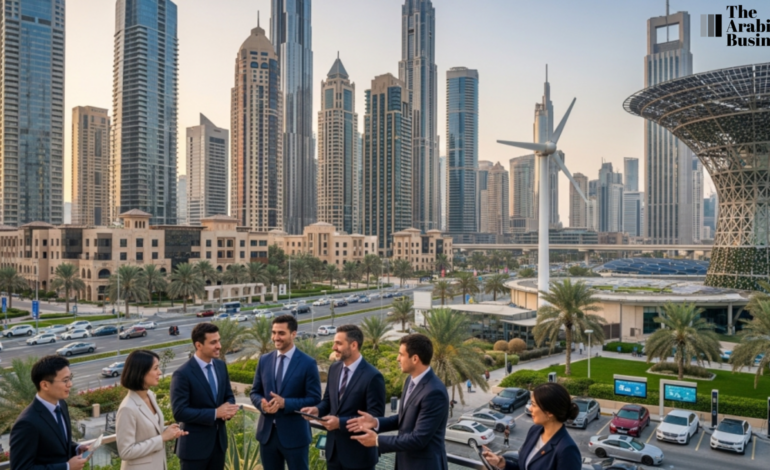
Sustainability has become a central pillar of economic strategy across the region. Governments and businesses are investing heavily in renewable energy, clean technologies, and sustainable infrastructure. Large-scale solar and wind projects, green hydrogen initiatives, and climate-focused policies reflect a growing commitment to balancing economic growth with environmental responsibility, while positioning the Middle East as a leader in the global energy transition.
Evolving Workforce and Talent Development
Human capital is at the heart of the region’s economic future. Education reform, skills development, and workforce nationalization programs are preparing a new generation of professionals for knowledge-based economies. At the same time, the Middle East continues to attract global talent, creating diverse, multicultural business environments that drive innovation and productivity.
A Future Defined by Opportunity
As economic reforms accelerate and innovation gains momentum, the Middle East stands at the forefront of global opportunity. Businesses that understand the region’s evolving priorities—diversification, digitalization, sustainability, and talent—are best positioned to succeed. The Arabian business pulse is strong, forward-looking, and increasingly influential in shaping the global economic narrative.